
Access-control system guide
Cloud-managed access control places some management functions or data in a hosted service. The doors may still make decisions locally through onsite controllers. A responsible evaluation separates everyday convenience from the internet, subscription, identity and recovery dependencies introduced by the service.
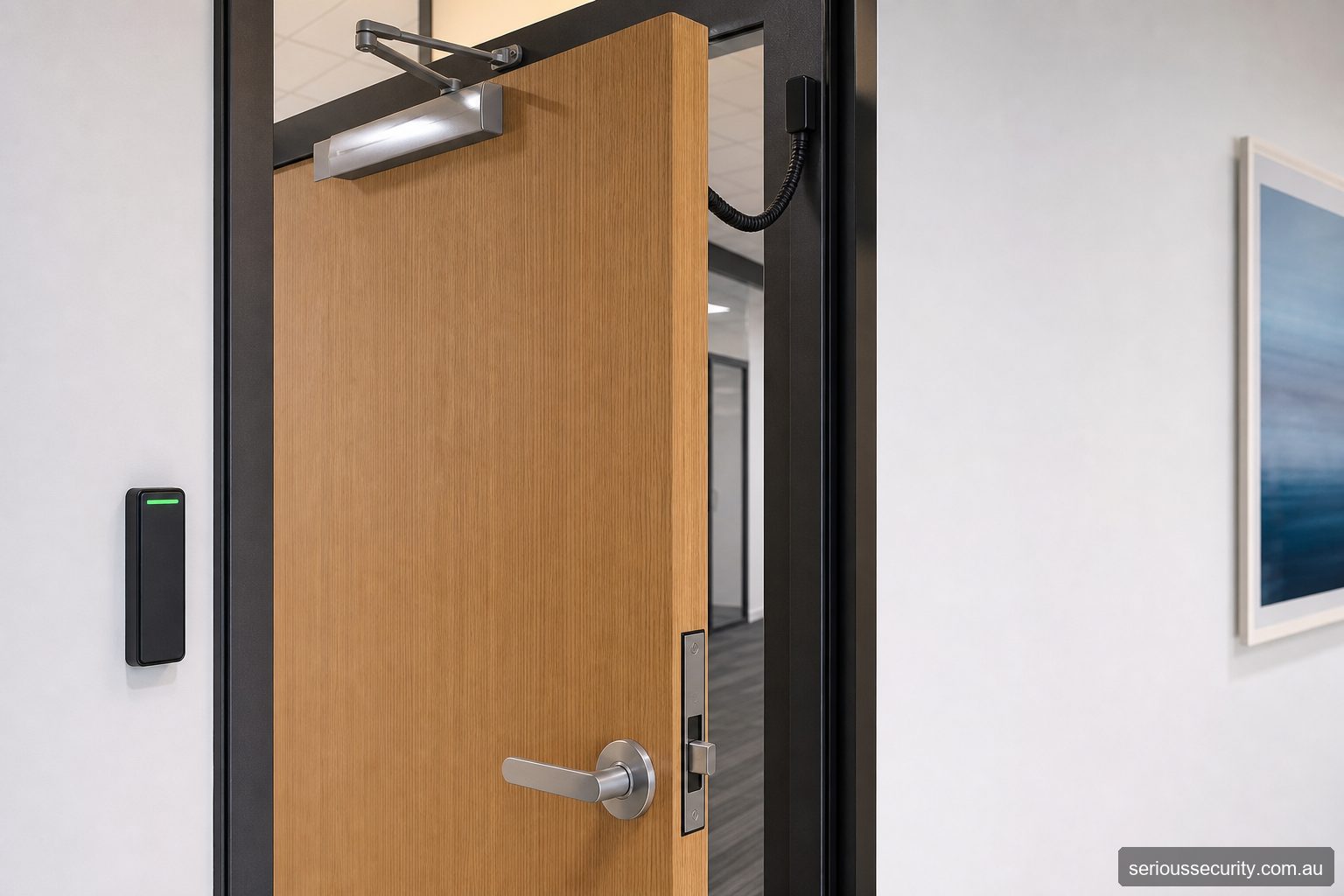
Separate cloud management from door operation
Ask where credentials, schedules and access decisions are stored. Many systems download rules to local controllers, allowing normal entry during an internet outage; others may depend more heavily on an online service. “Cloud based” alone does not answer this.
Document what administrators can and cannot do when the site, internet connection, vendor service or identity provider is unavailable.
Evaluate the service, not just the hardware
Confirm hosting region where relevant, service ownership, administrator authentication, logging, encryption claims, backup, data export, update responsibility, support and end-of-contract arrangements. Review the supplier’s current security and privacy documentation rather than relying on a sales summary.
Ask how the organisation regains control if the integrator relationship changes and whether configurations, users and events can be exported in a usable form.
Understand recurring and scaling costs
Hosted management may involve site, door, user, credential, feature or support charges. Request the billing basis, term, renewal, price-change mechanism and consequences of non-payment or cancellation.
Compare total ownership with an on-premises design, including servers, backups, remote access, software support and internal IT effort. Neither model is cost-free.
Secure privileged access
Use named administrator accounts, strong authentication, least privilege and regular access review. Avoid shared installer logins and remove temporary vendor access after authorised work. Integrations and API credentials need the same care as human accounts.
Where single sign-on is offered, confirm lifecycle and emergency-access arrangements rather than assuming it automatically improves governance.
Plan outage and exit scenarios
Test or verify normal door operation, remote commands, enrolment, event buffering and alarm delivery during relevant outages. Keep contact and recovery procedures outside the unavailable platform.
Before signing, know how credentials will be migrated and doors kept operational if the service is replaced.
Map cloud responsibility explicitly
| Responsibility | Questions to resolve |
|---|---|
| Identity and administration | Who creates administrators, enforces multi-factor authentication, reviews privileges and recovers a locked account? |
| Door continuity | Which decisions remain local during internet or service loss, how long can devices operate, and how are events reconciled? |
| Data and privacy | What people, credential, event and video data is stored; in which regions; for how long; and how is it exported or deleted? |
| Updates and vulnerabilities | Which party patches field devices, gateways, applications and integrations, and how are security advisories communicated? |
| Backup and exit | What is backed up, how is recovery tested, and what usable data and configuration can the customer obtain when the service ends? |
| Incident response | Who detects, contains and reports an incident across the provider, installer, customer network and any integration partner? |
Australian Signals Directorate cloud guidance describes cloud security as a shared responsibility. Although its formal assessment material is aimed particularly at government use, the central lesson is useful for any buyer: document which controls are supplied by the cloud service and which remain with the customer and other parties. See the ASD cloud assessment and authorisation guidance.
Ask for a failure demonstration, not only a dashboard demonstration
During evaluation, enrol and revoke a test user, change a schedule, review a forced-door event and export an audit record. Then test a defined internet interruption, loss of the administrator’s phone and departure of the original account owner. A polished dashboard does not answer how the physical doors behave through those events.
Questions about cloud access control
Will doors stop working if the internet fails?
Not necessarily, but the answer is architecture-specific. Confirm which decisions remain local, how long they continue and which management functions become unavailable.
Where is access data stored?
It may exist onsite, in the hosted service or both. Obtain a current data-flow description and review it against the organisation’s privacy and security requirements.
Are cloud systems subscription based?
Many are, but charging models differ. Require written pricing for the proposed doors, users, credentials and features.
Who installs updates?
The provider may update hosted software while onsite controllers, readers, apps or gateways have separate responsibilities. Record ownership for every layer.
Can the organisation change installers?
That depends on account ownership, product channels and contractual arrangements. Confirm administrative ownership, export and support transfer before purchase.
Assess the site before selecting a platform
Send door photographs or plans, user numbers, credential preferences, integrations and operating requirements. Serious Security can assess commercial projects in Sydney and Melbourne.