
Commercial access control
There is no responsible flat “price per door” that applies to every commercial access-control project. Two visually similar entrances can require very different work because of door construction, existing hardware, cable access, emergency-release requirements and the way the organisation wants to manage users.
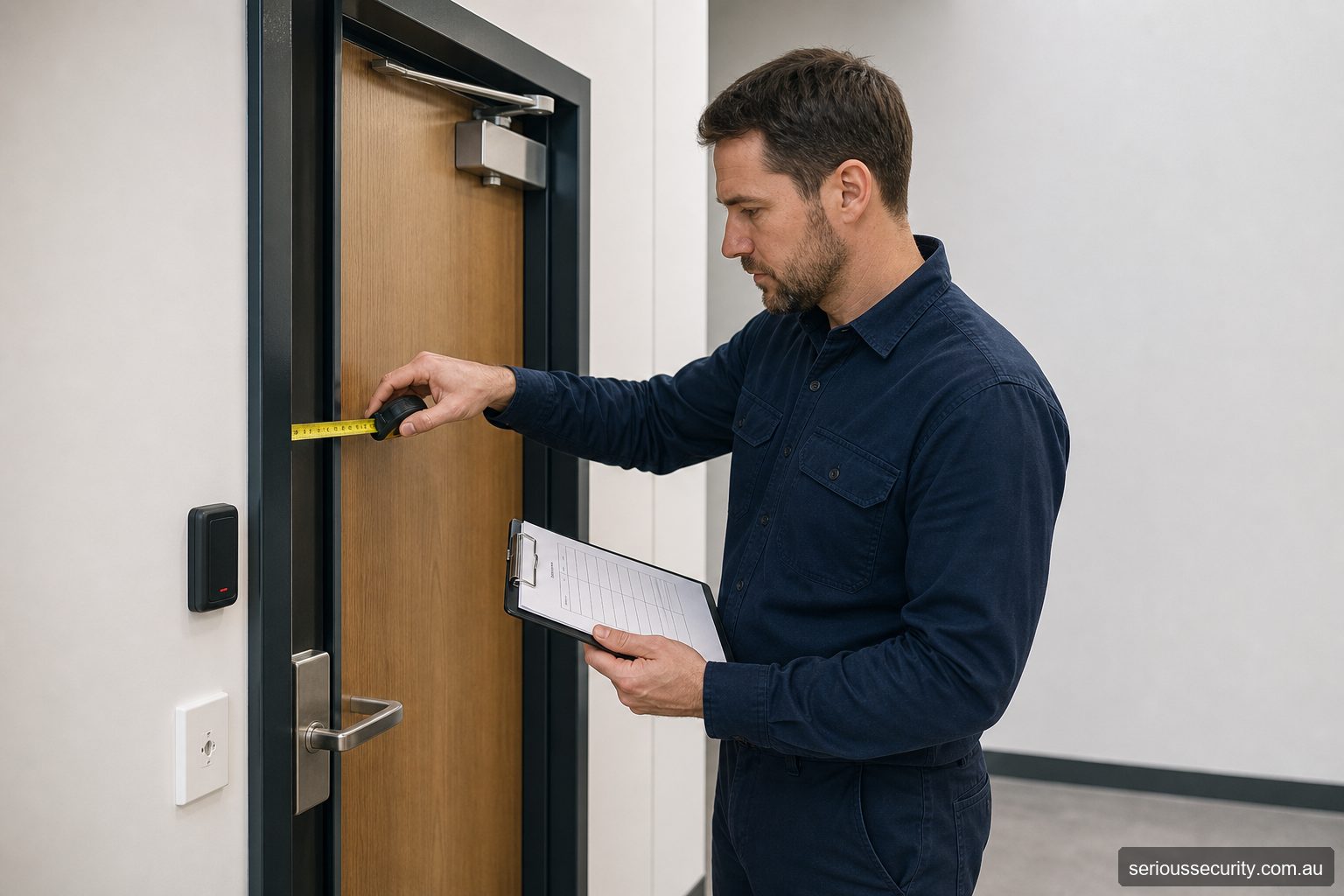
The door usually determines the labour
A sound timber internal door with an accessible frame may be straightforward. A frameless glass entrance, fire-rated opening, automatic door, external gate or misaligned steel frame can require specialist hardware, additional trades and more commissioning time. Existing locks and closers may need repair before electronic control will be dependable.
Count doors, but describe them as well. Photos, plans and a site survey help turn a rough allowance into a defensible scope.
Equipment cost is more than a reader
A controlled opening may require a reader, controller capacity, electric lock, door contact, request-to-exit device, emergency-release arrangement, power supply, battery, enclosure, cabling and credentials. Network switches, secure remote access, software licences or subscriptions may also be relevant.
Brand and credential choices affect cost, but selecting the cheapest reader while ignoring the lock and power design is false economy.
Integration changes scope quickly
Alarm integration may be a simple programmed relationship within one platform or a connection between separate systems. CCTV event association, video intercom release, automatic doors, boom gates, ANPR and lift control can require interfaces, licences and coordination with other contractors.
Ask the proposal to state exactly what the integration does. “CCTV compatible” is not the same as a tested workflow that retrieves the correct camera when a door event occurs.
Allow for implementation and ownership
User enrolment, access-level design, administrator training, documentation, configuration backups and staged cutover all take time. Occupied premises may require after-hours work or temporary access arrangements. Multi-site administration can add network and governance tasks even when the door hardware is simple.
Ongoing costs may include replacement credentials, batteries, preventive maintenance, software support and subscriptions. These should be separated from once-off installation costs.
How to obtain a useful quote
Provide a door list, photos or plans, approximate user count, credential preference, required integrations, network constraints and expected growth. Ask for inclusions, exclusions, assumptions, model numbers where appropriate and a clear description of handover.
Serious Security should assess the site and prepare an itemised proposal; this draft deliberately does not repeat unverified prices from older web pages.
Cost factors to put beside every door
| Factor | What changes the scope |
|---|---|
| Door and frame | Material, condition, alignment, fire rating, glass, weather and existing preparation |
| Locking | Strike, mortice lock, magnetic lock or specialist hardware; current draw and mounting |
| Exit and monitoring | Request-to-exit, emergency release, door contact and held-open requirements |
| Cabling | Distance, access, concrete, ceiling type, occupied areas and making good |
| Control and power | Available controller capacity, enclosure, power supply, battery and distribution |
| Management | Software, licences, hosting, network, workstations, backups and remote access |
| Implementation | Programming, enrolment, migration, after-hours work, training and documentation |
Why the lowest total may not be the lowest-cost solution
Imagine two proposals for four doors. One includes new locks, monitored door contacts, backup power, named credentials, administrator training and a final door schedule. The other reuses untested locks, omits monitoring and assumes the client will program users. The totals cannot be compared as equivalent four-door systems.
Ask each supplier to price the same documented outcome. If an item is optional, show the operational consequence of excluding it. This is more useful than forcing every proposal into an artificial per-door rate.
Separate once-off and ongoing costs
- Once-off: survey, design, hardware, cabling, installation, programming, migration, credentials, training and documentation.
- Periodic: preventive maintenance, battery replacement, software support and review of doors and users.
- Usage or service based: confirmed cloud subscriptions, mobile credentials, hosted services or third-party licences.
- Future change: additional doors, replacement credentials, site expansion and integration changes.
Request the term, renewal basis and consequence of cancellation for any recurring service. Do not assume “cloud” always means a fee or that “on-premises” has no ongoing cost.
Information that makes pricing more reliable
- Numbered door list with photographs and location
- Door type, known fire status and existing hardware
- User numbers, groups, shifts and visitor requirements
- Credential preference and whether existing credentials are proposed for reuse
- Alarm, CCTV, intercom, gate, lift and automatic-door requirements
- Network, power and remote-management expectations
- Working-hour constraints, permits and induction requirements
- Training, documentation and maintenance expectations
Frequently asked questions
Can you price access control from photos?
Photos and plans can support an early estimate, but an itemised fixed scope usually requires inspection of door condition, hardware, cable routes, power and relevant interfaces.
Why do quotes for the same number of doors differ?
They may include different locks, power supplies, credentials, software, integration, door repairs, documentation or after-hours work. Compare the door schedule and exclusions, not only the total.
Are there ongoing costs?
Possibly. Allow for credentials, batteries, maintenance, software support and any confirmed subscription or licence fees.
Should access-control quotes include door repairs?
Where alignment, closers, frames or existing locks affect reliable operation, the proposal should include the repair or clearly assign it to another contractor. Omitting it does not remove the requirement.
How should subscriptions be compared?
Record the billing unit, included features, minimum term, renewal, price-change basis, support and what happens to management or credentials if the service ends.
Prepare an access-control brief
Send Serious Security the door locations, approximate user numbers, plans or photographs, required integrations and likely growth. The team can assess the site and prepare an itemised proposal for Sydney or Melbourne.
Request an itemised access-control quote Sydney: (02) 8734 3250 Melbourne: (03) 8513 0799