
Reader and credential guide
HID is relevant to access-control projects primarily through credential and reader technologies. Selecting “HID” does not by itself identify the credential security, reader-to-controller protocol, mobile service, encoding, compatibility or door platform. Those choices need to be documented for the exact proposed system.
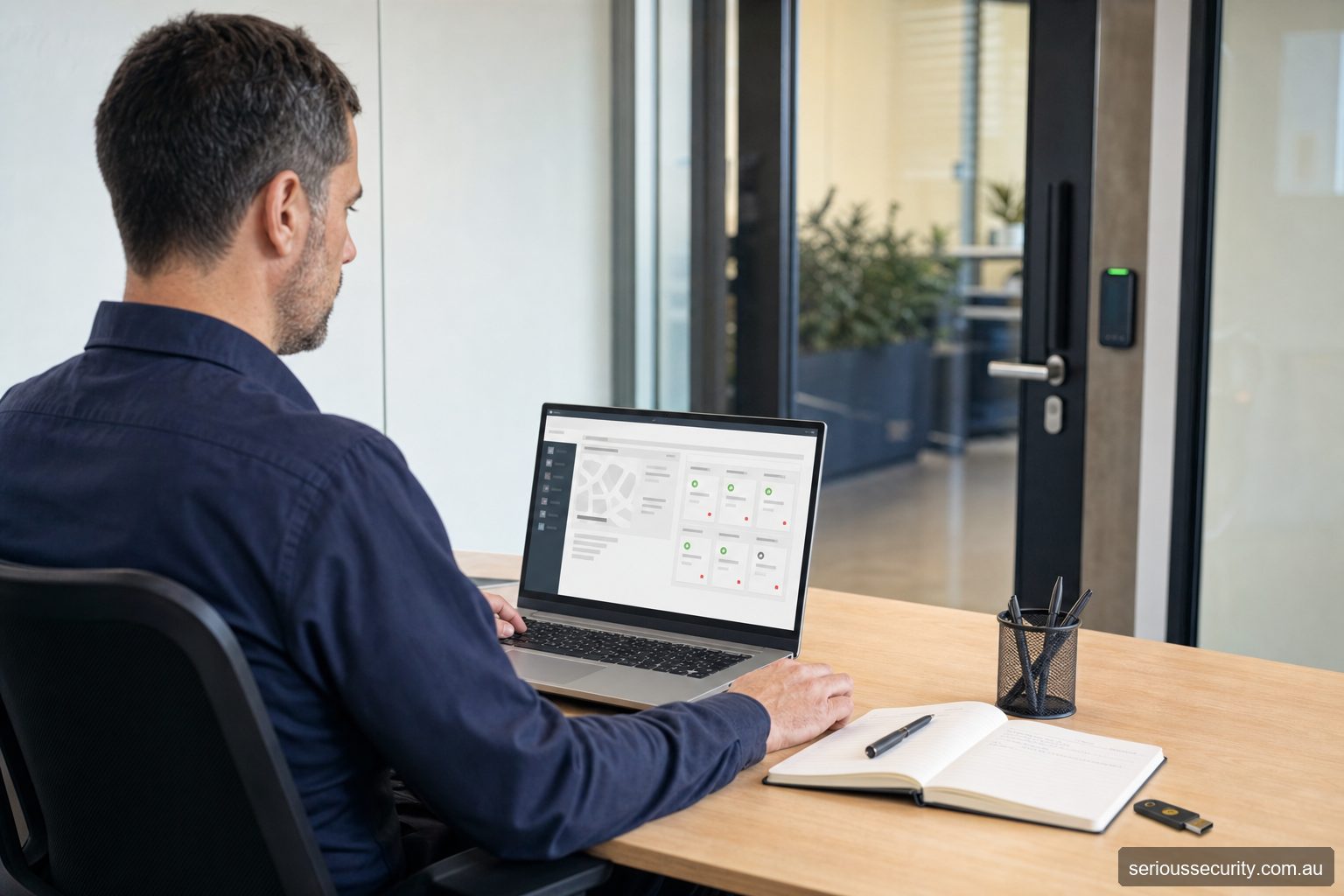
Separate the credential from the access platform
A card, fob or mobile credential carries or presents identity data. A compatible reader receives it; the access controller still decides whether that user may enter this door at this time. Management software, locks, power and door monitoring are separate parts of the design.
Serious Security’s current integrated-access page references HID iCLASS SE and multiCLASS SE reader families, HID Mobile Access, cards and fobs. Treat that as evidence of the business’s existing service language, not confirmation that every current HID product is offered or suitable.
Choose credential technology deliberately
Current HID material describes Seos as using modern cryptography and mutual authentication and supporting physical-access and other applications. Legacy proximity and older smart-card estates may have different security characteristics. Ask what technology is actually encoded and enabled—not merely what logo appears on the card.
Where existing credentials are proposed for reuse, verify technology, key ownership, encoding, reader support and the risk of retaining legacy modes. A multi-technology reader can assist staged migration, but leaving weaker technology enabled indefinitely can preserve the original risk.
Verify reader communication
Selected current HID readers support OSDP as well as older interfaces. OSDP can provide supervised bidirectional communication and, in supported secure configurations, stronger protection than an unsupervised one-way interface. Compatibility requires support and correct configuration at both the reader and controller.
Specify reader model, enabled credential technologies, controller interface, secure-channel requirement, firmware and configuration ownership. Do not assume a capable reader was commissioned in its strongest mode.
Assess mobile credentials as a service
Mobile capability depends on supported readers, phones, enrolment services, accounts, licences and the organisation’s device policy. Document invitation, activation, lost phone, replacement, revocation, offline behaviour and an alternative for authorised users who cannot use the mobile method.
Mobile credential presentation at a reader is not the same as an operator remotely unlocking a door.
HID migration checklist
- Inventory cards, fobs, readers, controllers and formats
- Identify legacy and stronger credential technologies
- Confirm encoding and key ownership
- Verify current reader and controller compatibility
- Decide whether old and new technologies coexist
- Set a date or risk trigger for disabling legacy modes
- Test issue, use, loss, revocation and replacement
- Retain model, firmware and configuration records
Understand the HID layer in the complete system
HID commonly supplies readers, cards, fobs, mobile credentials and supporting management tools; the access-control panel or platform normally decides whether a person may use a door. Therefore “we use HID” does not identify the credential technology, reader configuration, controller protocol, encryption keys, mobile service or access platform.
| Decision | Why it matters | Evidence to request |
|---|---|---|
| Credential technology | Legacy proximity, iCLASS, Seos and other supported technologies do not provide identical security or lifecycle options. | Exact credential part/profile, encoding specification, ownership of keys and current lifecycle status. |
| Reader-to-controller protocol | A reader’s credential capability is different from how it communicates with the controller. | Supported OSDP or other interface, secure-channel configuration where applicable, supervision and cable design. |
| Migration mode | Multi-technology readers can ease transition but may leave weaker legacy technology enabled indefinitely. | Migration stages, reader configuration record, target completion date and method for disabling the retired technology. |
| Mobile credentials | Provisioning, phone compatibility, account ownership and licences affect the whole user lifecycle. | Supported reader/configuration, issuing and revocation workflow, subscription and fallback credential. |
Example: migrate without replacing every credential on day one
A site with an older credential population may install compatible migration readers that can temporarily read both the existing technology and a selected newer credential. New starters and replacement cards move to the target credential first; remaining users migrate in planned groups. Once old credentials are removed and exceptions resolved, legacy reading is disabled rather than left as a permanent bypass.
This approach requires a verified inventory and test cards. Matching the visible card or reader brand is insufficient: part numbers, programming, formats, facility codes, encryption keys and panel compatibility determine whether reuse or migration is possible. HID’s current product and lifecycle material should be checked for every proposed component, including the HID credential lifecycle register.
Questions about HID access control
Will every HID card work on every HID reader?
No. HID covers multiple technologies and configurations. Verify the exact credential, frequency, encoding, keys, reader model and enabled modes.
Can existing proximity cards be retained?
Possibly, but compatibility is only one consideration. Assess legacy security, ownership and whether reuse undermines the purpose of an upgrade.
Does an HID reader include the controller?
Usually the reader passes credential information to a separate controller, although architectures vary. Confirm the proposed components.
Is OSDP automatically secure?
No. Both ends must support and correctly configure the required mode, including secure channel where specified.
Can cards and phones be used together?
Selected architectures support mixed credentials, subject to current reader, controller and service compatibility.
Official sources and further reading
- HID Seos Card — accessed 12 July 2026
- HID iCLASS SE R95 reader information — accessed 12 July 2026
- Serious Security integrated access-control solutions — accessed 12 July 2026
Model availability, support, licences and compatibility require technical confirmation before publication and procurement.
Plan a credential migration
Provide details or samples of the existing credentials, readers, controllers, user count and desired mobile or card outcome.